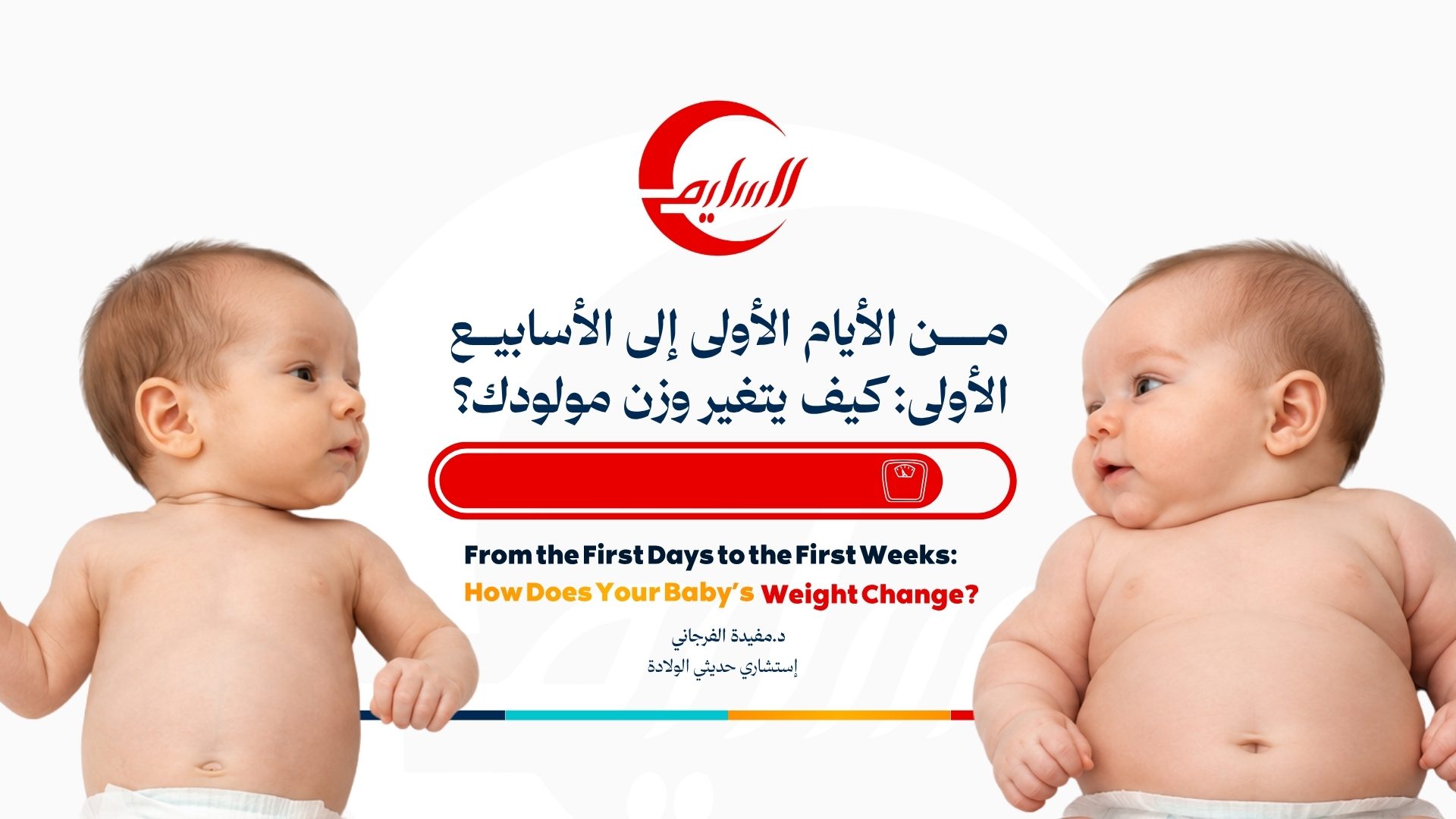
From the First Days to the First Weeks: How Does Your Baby’s Weight Change?
A couple of days ago, in our neonatal follow-up clinic, we were talking with a mother about her baby’s weight gain and reassuring her that it was good. She told me that her target was for her baby’s weight to become double the birth weight by 40 days of age, noting that his birth weight was 4 kg!
In this short article, we will talk about the normal weight gain of a newborn, the factors that affect weight gain, and when weight gain is considered normal or abnormal.
The normal weight of a full-term baby ranges from 2.5 to 4 kg. It is normal for a newborn’s weight to decrease by 5–10% after birth due to the loss of excess body fluids, the passage of meconium (the first stool), and the establishment of regular feeding during the first few days. Usually, the baby regains the birth weight within 5–7 days, after which daily weight gain begins.
Daily weight gain ranges from 15 to 30 g per day, which is approximately 150 to 200 g per week during the first two months of life. A baby’s weight usually doubles by 6 months of age. For example, a baby who weighs 4 kg at birth is expected to weigh about 8 kg by 6 months.
Factors Affecting Weight Gain
The baby’s health condition:
In cases of prematurity or low birth weight, weight gain may be lower than normal for several reasons, including poor sucking ability.
Feeding method:
A low number of feeds (the normal range is 7–8 feeds per day), ineffective feeding, an improper latch, cracked nipples, or incorrect preparation of formula milk can all affect weight gain.
Mother’s health:
Poor maternal health due to illness or malnutrition can also affect the baby’s weight.
What Is Abnormal Weight Gain?
Abnormal weight gain may be either less than normal or more than normal.
Less than normal weight gain:
If the baby does not regain the birth weight within 10–15 days, or gains only 10–15 g per day, the cause may be poor or infrequent feeding, incorrect formula preparation, or, God forbid, an underlying illness.
More than normal weight gain:
If the baby gains 30–40 g per day, or more than 250–300 g per week, with obvious obesity, the most common cause is overfeeding. In rare cases, a hormonal disorder or a genetic disease may be responsible.
In conclusion, it is normal for a newborn to lose some weight during the first few days of life. The normal rate of weight gain during the first months is 15–30 g per day. Proper breastfeeding every 2–3 hours supports healthy growth. Weight gain that is either below or above the normal range requires evaluation by a healthcare professional.